


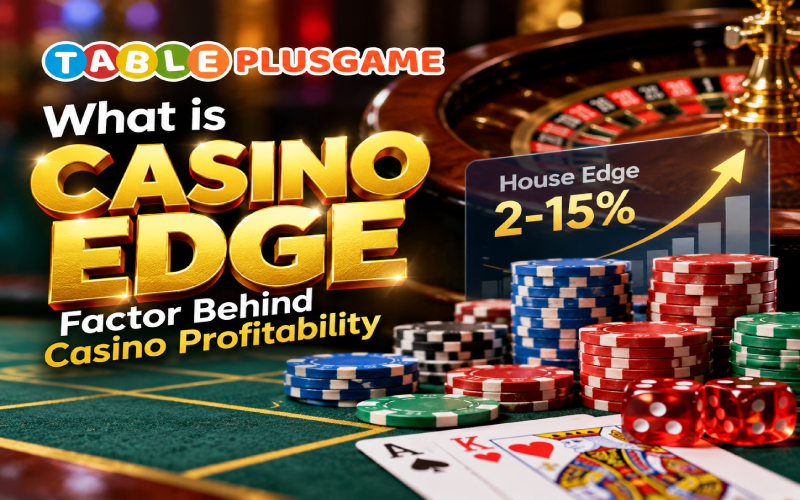
Ever wondered why a casino can keep making money even when some players win big? The answer lies in mathematics, not a guarantee that every player will lose. Understanding what is casino edge helps explain why casinos maintain a long-term advantage and why individual results can vary so widely. For Filipino adults who enjoy table games or live dealers, knowing how this percentage works can help set realistic expectations and make more informed decisions.
What Is Casino Edge?
Casino edge, also called the house edge, is the built-in statistical advantage a casino has over players. Expressed as a percentage of wagers, it estimates how much a casino expects to retain over a large number of bets.
For example, a 2% house edge means the casino expects to keep an average of ₱2 for every ₱100 wagered over time. It doesn’t mean the casino takes ₱2 from every individual bet or that a player will lose exactly ₱2 in a single session.
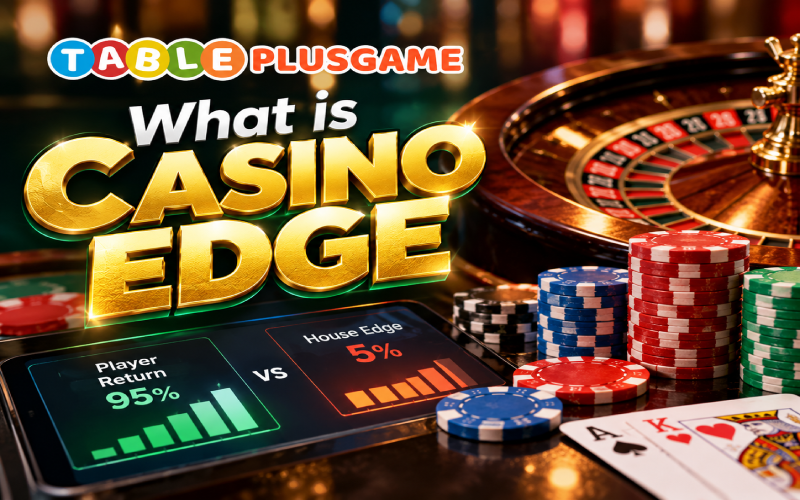
Another useful measure is return to player (RTP). RTP represents the theoretical percentage of total wagers returned to players over time. For games where these figures are complementary, the relationship is:
RTP = 100% − house edge
A game with a 2% house edge therefore has a theoretical RTP of 98%. Neither figure predicts what will happen during one playing session.
How Casino Edge Creates Profit
The casino edge works through probability and the law of large numbers. As the number of independent bets increases, actual results tend to move closer to their expected statistical average, although short-term fluctuations can remain substantial.
This is why a player might win ₱5,000 in one session while a casino still earns money across thousands of other wagers. The player’s result reflects short-term variance, meaning the natural ups and downs of random outcomes. The house edge describes the longer-term mathematical expectation.
Consider a simplified example: if a game has a 2% house edge and receives ₱1 million in total wagers, its theoretical expected house win is ₱20,000. That’s not guaranteed revenue for that period. Actual results can be higher or lower, and total wagers are not the same as deposits or casino profit after operating costs.
The concept of expected value helps explain the difference. It measures the average result a bet would produce if repeated under the same conditions over the long run. A negative expected value means the player loses money on average over time, even though individual wins remain possible.
Casino Edge by Game: Typical House Edges
Different table games have different mathematical advantages. The figures below are commonly cited theoretical estimates, not guaranteed outcomes for every online or live table.
| Casino game and bet | Typical house edge |
|---|---|
| Baccarat — Banker | About 1.06% |
| Baccarat — Player | About 1.24% |
| Baccarat — Tie | About 14.4% |
| Blackjack — basic strategy | Around 0.5% under favourable rules |
| European Roulette | 2.70% |
| American Roulette | 5.26% |
| Dragon Tiger — Tie | Often around 30% or higher, depending on rules |
Exact edges vary with table rules, payouts, commission structures and game variants. Blackjack’s low estimate assumes appropriate basic strategy and suitable rules; playing decisions can increase the house advantage. Dragon Tiger tie bets are especially costly in many versions because of their low probability and payout structure, so players should check the posted rules before wagering.
In general, lower house edge means a smaller theoretical loss relative to the amount wagered. It doesn’t mean a game is risk-free or that a player will necessarily get better results in a short session.
Casino Edge on TablePlus
Table games and live dealer games offered through TablePlus, also known as Table Game Plus, follow the same probability principles as equivalent games elsewhere. A live dealer and a digital interface can change the playing experience, but we don’t automatically change a game’s mathematical edge.
The important details are the specific game, its rules, the available bets and the published payouts. Players should review these before playing rather than assuming every table has identical odds.
For more platform-specific context, consult a TablePlus live casino review when assessing live table features and a TablePlus GCash review when looking into payment convenience. GCash and Maya will offer convenient payment options where supported, but availability, transaction limits, fees and withdrawal processing times can vary. Confirm the current terms directly with the operator.
PAGCOR is the Philippine regulator for licensed gaming operations. Before using any online casino, independently verify the operator’s current licence and the status of the specific platform. Don’t assume that a game is independently audited simply because it is available online; look for verifiable testing information from recognised testing laboratories where applicable.
Smart Player Takeaways: Managing Casino Edge
Understanding the house edge won’t eliminate risk, but it can help players make more informed choices.
- Compare house edges. When comparing games, consider lower-edge options and examine the rules of each individual table.
- Learn basic strategy. In blackjack, appropriate decisions can reduce the house advantage under favorable you reach that limit. Never use money needed for bills, food or savings.
- Treat bonuses cautiously. Promotions will have wagering requirements, game restrictions and expiry dates. Read the terms and treat bonuses as entertainment value, not guaranteed profit.
- Don’t chase losses. Increasing bets to recover previous losses can quickly turn a manageable expense into a serious financial problem. Take a break when emotions begin influencing decisions.
Responsible Gaming: Know Your Limits
Casino games are entertainment, not a reliable source of income. Participation should be limited to adults aged 21 and above, and players should follow applicable Philippine laws and platform eligibility requirements. Never gamble with borrowed money or funds needed for essential expenses.
If gambling becomes difficult to control, stop playing and seek support. In the Philippines, you can contact the PAGCOR Responsible Gaming programme for guidance and support options. Asking for help early is a practical step, not a failure.
FAQs About Casino Edge
Casino edge is the percentage advantage a casino has over players in a game. For example, a 2% house edge means the casino expects to retain ₱2 for every ₱100 wagered over many bets. Individual results can differ significantly, so this percentage doesn’t predict the outcome of a single game.
Yes. Casino edge and house edge generally refer to the same mathematical advantage. It’s usually expressed as a percentage of wagers and reflects the casino’s expected long-term return. A lower house edge means a smaller theoretical loss per peso wagered, but it doesn’t guarantee that players will win or lose less in every session.
Blackjack can have a house edge of around 0.5% when players use correct basic strategy and the table offers favourable rules. Baccarat’s Banker bet is another relatively low-edge option at approximately 1.06%. Actual figures vary by game conditions, so always check the rules and payouts before placing a bet.
Yes, a player can win in the short term, and skilled decisions can reduce the house edge in certain games. However, winning a session doesn’t eliminate the casino’s long-term mathematical advantage. No betting system guarantees consistent profits, and increasing stakes to recover losses can make financial harm more likely.
The house edge primarily depends on the game’s rules, payouts and betting options, not the platform’s name. TablePlus games can have different edges depending on the specific table and variant. Compare published rules, commissions and payouts rather than assuming one platform is automatically better. Check each table’s information before wagering.