


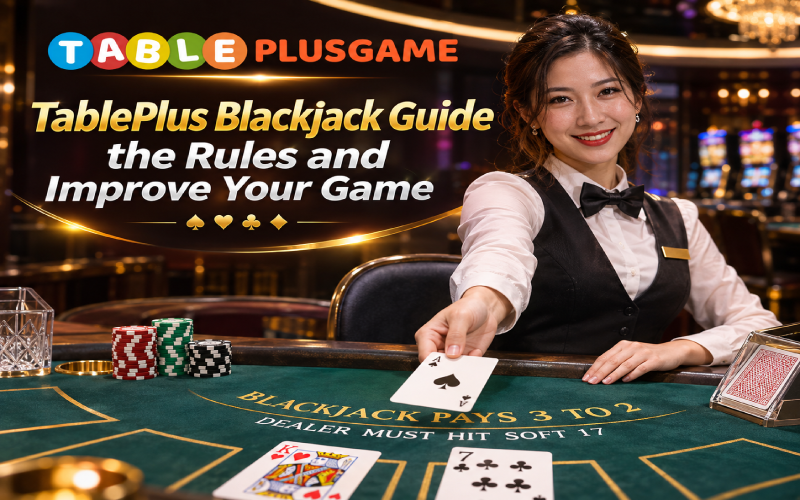
Facing a hard 16 against a dealer showing 10 is uncomfortable. Should you hit and risk busting, or stand and hope the dealer goes over 21? Decisions like this make blackjack interesting. This tableplus blackjack guide explains the rules, important table variations, and practical basic-strategy decisions. Whether you’re a beginner or a casual Filipino player, you’ll learn how to make more informed choices before placing your next bet.
How TablePlus Blackjack Works
The objective of blackjack is simple: get a hand total closer to 21 than the dealer without going over. Number cards retain their face values, face cards (Jack, Queen, and King) count as 10, and an Ace counts as either 1 or 11, whichever benefits your hand.
A round starts with players placing bets and receiving two cards. The dealer also receives two cards, usually one face-up and one face-down. After checking their hand, players choose from several actions:
- Hit: Take another card to improve your total.
- Stand: Keep your current hand and end your turn.
- Double down: Double your original bet, receive one additional card, and stand.
- Split: Separate matching-value starting cards into two hands, placing an additional equal bet.
- Insurance: Make a separate side bet when the dealer shows an Ace, protecting against a possible dealer blackjack.
After players finish, the dealer reveals their hidden card and follows the table’s required drawing rules. The highest qualifying hand wins, while a dealer blackjack can change the outcome immediately.
Remember that rules can differ between tables. Check the in-game rules panel before betting, especially for blackjack payouts, dealer soft 17 decisions, and splitting restrictions.
Rule Variations and What You Do to the House Edge
Not every blackjack table offers the same mathematical advantage. Small rule differences can affect the house edge, which represents the casino’s long-term expected advantage over players.
The following figures are approximate, based on published multi-deck blackjack odds analyses, including research from Wizard of Odds. We are general reference figures, not confirmed TablePlus-specific statistics.
| Rule variation | Typical effect on house edge | What it means for you |
|---|---|---|
| Blackjack pays 6:5 instead of 3:2 | +about 1.4% | A ₱100 blackjack pays ₱120 instead of ₱150. Avoid when possible. |
| Dealer hits soft 17 (vs stands) | +about 0.2% | Slightly worse for players. |
| Double after split allowed | −about 0.1% | Gives you more options and is favorable. |
| Late surrender available | −about 0.07% | A small edge when used correctly. |
| Basic strategy baseline (multi-deck) | About 0.5% overall | A relatively low house edge when you play correctly. |
Note: Figures are approximate and vary by rule set; always check the rules displayed on the specific table.
The difference between 3:2 and 6:5 is particularly important. A natural blackjack pays ₱150 on a ₱100 bet at 3:2, compared with just ₱120 at 6:5. That difference adds up over repeated hands, making payout terms worth checking before choosing a table.
Basic Strategy You Can Use Tonight
Basic strategy uses mathematical probabilities to guide your decisions based on your cards and the dealer’s visible card. It won’t predict individual outcomes, but it helps reduce avoidable mistakes.
Here are six useful starting points:
- Always split Aces and Eights. Two Aces can create stronger starting hands, while splitting Eights turns a difficult 16 into two separate hands.
- Never split Tens. A total of 20 is already a strong hand. Breaking it up creates unnecessary risk.
- Stand on hard 17 or higher. Taking another card creates a significant bust risk.
- Double 11 against dealer 2–10. Your starting total gives you a good opportunity to reach a strong hand with one additional card, subject to the table’s rules.
- Hit hard 12–16 against dealer 7 or higher. The dealer has a stronger upcard, so standing often leaves you relying on the dealer to bust.
- Never take insurance. As a standard basic-strategy recommendation, insurance is generally an unfavorable side bet over time.
Here’s a practical example: you’re holding 8-8 against a dealer’s 6. Your total is 16, which is a weak starting position. Splitting gives you two hands beginning with 8, allowing each to develop separately while the dealer faces a relatively weak upcard.
I initially found splitting Eights counterintuitive because it meant putting more money into a difficult situation. However, understanding the probabilities makes the decision easier.
Basic strategy lowers the house edge, but it cannot guarantee profit. The correct decision can still lose because blackjack involves randomness.
Blackjack vs Baccarat on the TablePlus Live Casino
Blackjack and baccarat offer different playing experiences on the tableplus live casino. Blackjack involves regular decisions about hitting, standing, doubling, and splitting, making it suitable for players who enjoy applying strategy.
Meanwhile, tableplus baccarat generally involves fewer decisions. Players choose between Banker, Player, or Tie, and the cards determine the result according to fixed dealing rules. Baccarat will suit casual players who prefer a simpler format, while blackjack appeals to those who enjoy making tactical choices. Neither game guarantees better results.
Play Responsibly
Set a budget before sitting down, establish a time limit, and never chase losses. For example, decide beforehand whether your entertainment budget is ₱500 or ₱1,000, and stop when you reach your limit.
Play only on properly licensed platforms, checking PAGCOR licensing as the Philippine standard for legitimate gaming operators. Filipino players must be at least 21 years old. If gambling stops being enjoyable, consult PAGCOR’s responsible gaming resources and consider taking a break.
Conclusion
Understanding tableplus blackjack starts with learning the rules, checking table variations, and applying basic strategy consistently. Start with low stakes, practise your decisions, and keep your budget under control. Better-informed play is always preferable to relying on luck alone.